|
JMS Pro Photo
Through the Lens
Quite some time ago, I was sorting through photos I had taken over the course of
several races. As with any other “shoot”, I had sorted through the images
selecting only the best and sharpest ones. What jumped out at me was the fact I
repeatedly had more quality images of the same cars and fewer quality images of
a different group of cars. I wasn’t exactly sure why.
I also observed how one image, when used in a racing publication, seemed to
stand out more than another image. Curiously, it seemed both images were equally
crisp and sharp in detail when viewed as a color negative or print.
After a great deal of investigation and reading, along with some classes at
Youngstown State University, at least some of my questions were answered.
While I understood the terms hue, contrast and intensity, I didn’t fully
recognize how they interacted through the camera lens. Additionally, I noticed
the effect of converting a color image to the levels of black and white as
occurs in the racing publications.
Without trying to bore you, I’ll present a few ideas and concepts.
Color schemes are significant, balanced associations of colors based on the
twelve hue color wheel. Using them eliminates the need for selecting colors
based on trial and error. These color schemes are beneficial for creating visual
unity and preventing poor color combinations.
 |
Twelve Hue Color Wheel
One key concept is the use of triadic colors. A basic triad consists of three
colors equidistant on the color wheel. Red, blue and yellow are the primary
colors and the best known triad combination. Secondary colors orange, violet and
green belong to another popular combination. Triadic colors are generally
considered to be pleasing to the eye.
Here is where we evaluate what happens when a race car’s colorful color paint
scheme is displayed in the B&W section of a racing paper. Since most of the
photos fall into this group, it is quite an important relationship to
understand. The three colors, when using a triad scheme, will all appear in
deeply contrasting shades of black to white. The overall balance of an image
will have a greater visual impact. Certain color combinations, while appearing
distinct in natural light will wash out or appear as the same shade of grey in
newsprint. Using a scheme based off of one half of the color wheel usually has
that effect.
Is the way your car appears in the B&W section important to you? I expect the
answer, by and large, is yes.
Complementary colors are those directly across from one another on the color
wheel. When used in combination, they enhance one another and also work well
together. It is not necessary to use all three colors in the triad. Two colors
can be used equally as well.
What I’m recommending is, select a paint or color scheme with a plan in mind.
You can begin with a single “favorite” color (or hue) and work from there.
With the information readily available on the internet, do a search on color and
some of the associated terms like triad, complimentary, analogous, core, and
neutral. See what happens when a color scheme that looks pretty good on the
track is printed in B&W newsprint.
OK, let’s move forward. Contrast, basically dark to light, is an essential
element necessary for a camera lens to focus quickly and accurately. In the
technical sense this is called intensity of color. Powder blue and navy blue
have a different intensities (or contrasts) of the same hue, blue. So, how does
this affect the image?
Since (camera) focus speed and accuracy is relative to contrast (and a few other
things), getting a sharp in-focus image is easier if the paint scheme has
greater contrast. Vertical contrast (lines running up and down) is especially
important. Yes, there are other ways of trying to obtain an in-focus image and
most photographers use several methods. However, the features built into today’s
top of the line photography equipment encourages the use of automatic
capabilities.
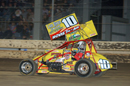
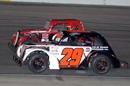
In plain English, if you break up a large solid color area (perhaps a sprint car
wing) with a vertical design or swoop in a contrasting color/intensity, the
greater the likelihood the photos of your car will be in better focus.
Is anyone asleep yet?
The latest wave of prism, reflecting and, ghosting vinyl (my most non-favorite)
presents a real catch-22 situation. From the grandstands, these materials are
fantastic, especially when the lights come on at night. Through the Lens
is a different story. When the sun is low on the horizon, around the time of hot
laps, qualifying and heat races, the glare from these materials can completely
ruin an otherwise good image. At night, the intense light of flash equipment
makes the situation even worse. The more these reflective materials are
incorporated into a paint scheme, the less chance there will be for great
images.
Have you seen the photos where there is a reflection or glare when there is a
car using these materials? Generally the result is a flipped glare, both
vertically and horizontally, somewhere else on the image. Quite often, this is
the car number. Removing these “ghosts” from an image is very time consuming and
generally just does not happen. Either a photo is submitted with the glare or it
is discarded. Rarely will these images be used by the racing publications in a
large format or on the cover.
If a photographer is at the track to get photos of one single car, there is time
to shoot that car repeatedly while hoping to get the perfect angle where the
glare is not present. Usually photographers do not have that luxury, so they
move on to something that works (like another race car).
Don’t get me wrong, I truly understand the dilemma. The overall effect of
today’s reflective materials is great! A conservative use is the best solution.
Before I wrap this section up, I want to mention the newer full body wraps (no
pun intended) for your race car. From a graphics perspective, this is probably
the easiest and possibly the cheapest way to get a large amount of detail onto a
car’s body.
I’m not sure how well I like them for two reasons. First, I personally do not
care for the lack of gloss. Secondly, the tendency toward excessive detail,
while looking great up close, is lost on the track. The multiple colors and
details wash out when viewed from a distance. Take a look from the stands and
see which cars you can pick out on the backstretch. The wraps can work but, be
careful to not over use detail.
After spending countless hours and ever increasing dollars on your race car, be
careful not to short change the exterior appearance. Spend some time thinking
about the color scheme, complexity of detail and the use of materials. There are
many great graphics shops around. My recommendation is to stop by several and
talk to the designer for their input. Get a feel for how well they understand
what you want your car to look like. Stand back and determine “what looks good
to you” both up close in the pits and at a distance from the stands.
They’re your wheels, take ‘em seriously!
Thanks for your interest,
Joe Secka – JMS ProPhoto
|